The Company That Owned Every Trailer for 40 Years
For four decades, almost every movie trailer in America came from one company you've never heard of. This is the story of the great trailer monopoly.
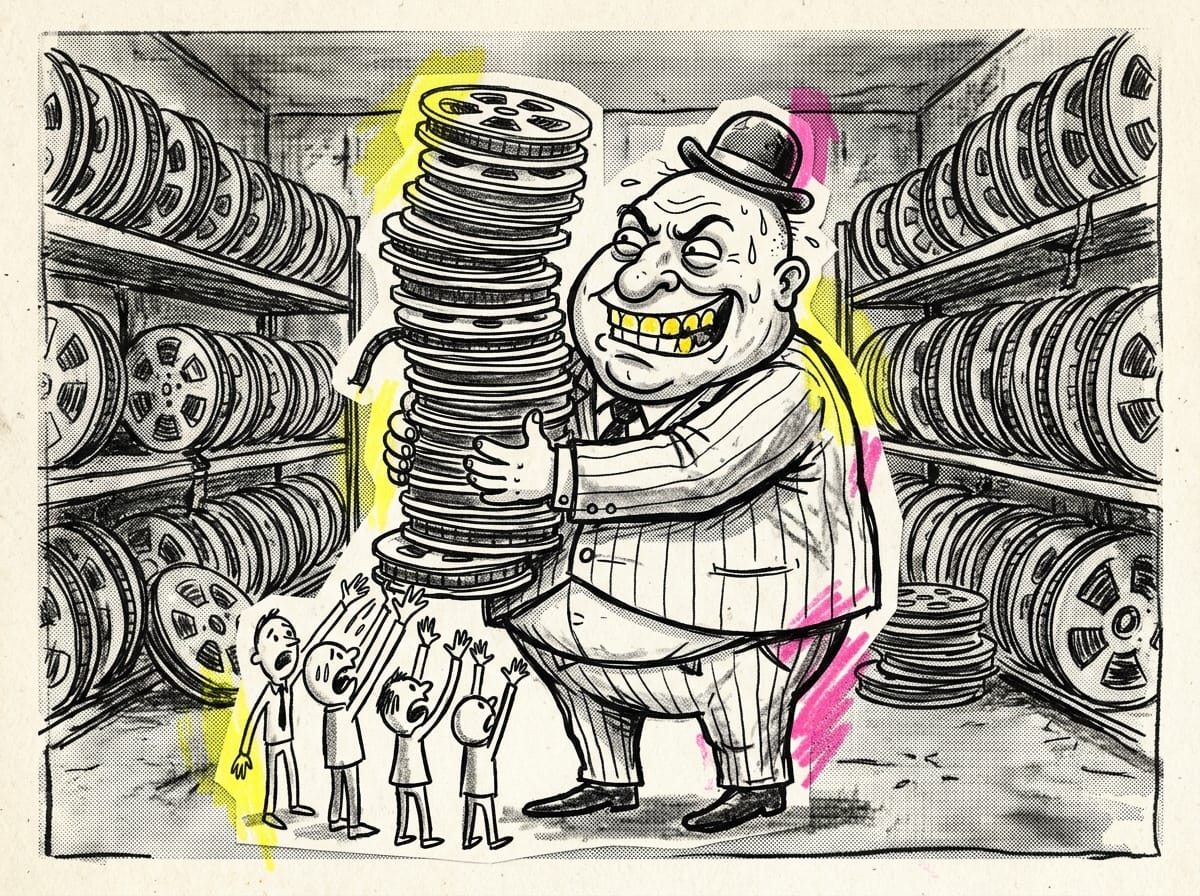
Here is a fact that should be strange and somehow isn’t widely known: for roughly forty years, almost every movie trailer an American saw in a cinema was made by the same company. Not by the studios. Not by the films’ own marketing departments. By one outside firm in New Jersey that most people have never heard of, and that quietly held a near-total grip on the way Hollywood advertised itself.
The company was National Screen Service, and its story is the story of how the trailer became an industry before it became an art.
A business nobody else wanted
National Screen Service was formed in 1920, and its founding insight was almost comically unglamorous. Making and shipping trailers was annoying. It was fiddly, low-margin, logistical work — cutting promotional reels, printing posters and lobby cards, and physically getting them to thousands of cinemas scattered across a country that, in 1920, had no reliable coast-to-coast phone service, let alone anything faster.
The studios, busy making films, didn’t especially want to deal with the nickel-and-dime grind of trailer distribution. So a group of businessmen figured out how to make money on exactly that grind — and in doing so built something far more powerful than the work looked. They didn’t own the films. They owned the pipes the advertising flowed through. And in Hollywood, distribution has always been where the real power sits. Anyone with capital can build a studio; getting your product in front of a paying audience is the hard part.
How the monopoly actually worked
The model was elegant. NSS made trailers and promotional materials on behalf of the studios, then rented those materials to cinema owners on a week-by-week basis, kicking a small royalty back to the studios. Everybody got paid, nobody else had to handle the logistics, and NSS sat in the middle of every transaction.
Then it tightened its grip. Beginning with Paramount in 1939, the major studios started granting NSS the exclusive right to manufacture and distribute their advertising materials — not just trailers, but posters, lobby cards, and the rest. RKO followed in 1940, Loew’s (MGM) in 1942, Universal in 1944, Columbia in 1945, United Artists and Warner Bros. in 1946, and 20th Century Fox in 1947. One by one, the giants signed up, until NSS controlled an estimated 85% of the major studios’ promotional distribution.
To deliver at that scale, NSS built a genuine industrial network — acquiring independent poster exchanges and running regional offices kitted out for printing, storage, and dissemination, feeding materials straight to theatres nationwide. It was less a creative house than a factory and a freight operation wearing a creative hat.
NSS didn’t own the films. It owned the pipes the advertising flowed through — and in Hollywood, the pipes are the power.
Why every old trailer looks the same
If you’ve ever watched a batch of trailers from the 1930s, 40s, or 50s, you’ll have noticed they feel oddly identical — the same screen-wipes, the same fly-in titles, the same breathless rhythm. That sameness isn’t a coincidence of the era’s taste. It’s a fingerprint. They came from one factory, built to one formula.
NSS industrialised the form. As early as 1924 it introduced what it called the “Unit Men” system — a standardised, almost modular approach that combined graphic titles, scene clips, and cast highlights into efficient, reusable trailer components. Think of it as an assembly line for hype: the same parts, reconfigured film to film. It was fast, it was cheap, it was consistent — and it produced the template-style trailer that defined the look of an entire age of cinema. (Watch the trailer for Casablanca and you’re watching the house style of a monopoly.)
This is the deep irony of early trailers: the thing we now think of as a piece of bespoke craft for each film was, for decades, mass-produced from a kit.
The empire cracks
No grip that tight goes unchallenged forever. As early as 1942, competitors in the same business launched an antitrust action against NSS and the studios that had handed it those exclusive licences. The legal fight ground on for years and eventually reached the U.S. Supreme Court as Lawlor v. National Screen Service in 1955 — a case still cited in antitrust law today. A district court had already found NSS’s exclusive arrangement to be an unlawful monopoly. The walls were closing in.
What ultimately ended the reign, though, was less the courts than change. Studios began experimenting with their own in-house trailer cutting again. The industry shifted. And by the time cinemas themselves transformed — from clusters of small individual screens into the big multiplexes of the 1980s — the world NSS had been built to serve had largely dissolved beneath it.
The ghost in the machine
National Screen Service is almost entirely forgotten now, which is exactly why it’s worth remembering. For forty years it shaped what going to the cinema felt like — the rhythm of the previews, the look of the poster in the lobby, the breathless voice promising the picture of the year. (That voice, incidentally, would later get its own king and its own strange extinction.)
It’s a useful reminder that the trailer has always been two things at once: an art form and an industry. We tend to remember the art and forget the industry. But the form we love was born in a warehouse, shipped by freight, and assembled from a standardised kit by a company whose name no one recalls — the same era, in fact, that gave us the strange backwards word “trailer” itself.
The next time a batch of old previews all feel cut from the same cloth, now you know: they were. Literally.
This is Trailer Trash. We make trailers for films that don’t exist — and write about the ones that do. Follow along on [YouTube], [TikTok], [Instagram], and [X].