When Trailers Lived on the Front of a Rented Tape
Before you could skip anything, the trailers on a rented VHS were a captive ritual — unskippable, half-remembered, and weirdly beloved. Here's why they vanished.
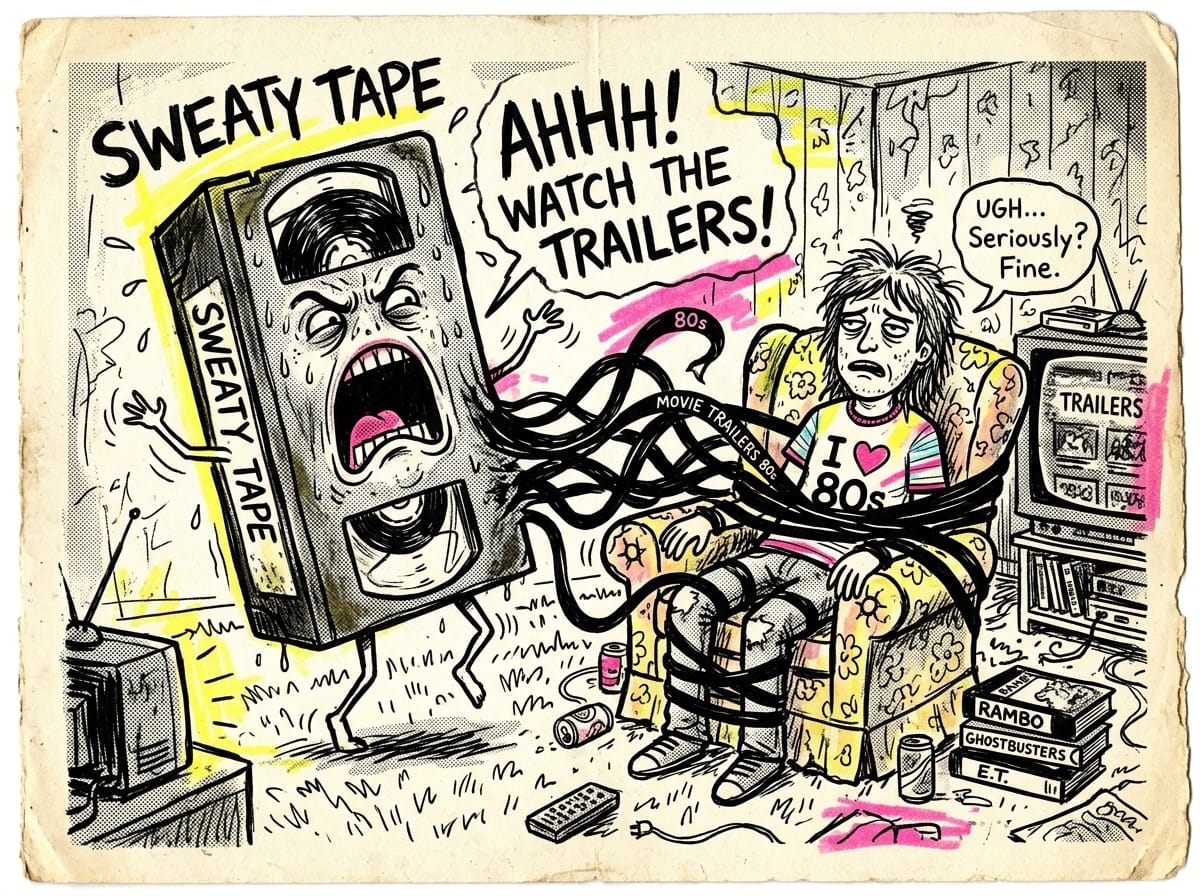
If you’re old enough, you can probably still hear it. A voice, slightly muffled by tape hiss: “Before you sit down to enjoy tonight’s feature, here are some coming attractions…” And then you’d sit there — because you had no choice — and watch trailers for three films you’d never see, on a tape you’d rented for the weekend from a shop that no longer exists.
The VHS trailer was a small, strange ritual, and it’s almost completely gone. Here’s why it existed, why a generation secretly loved it, and what its disappearance actually tells us.
It started as a packaging accident
The honest origin of the VHS trailer isn’t romantic. It’s about leftover space.
A VHS tape in standard play held about two hours. Most films ran around ninety minutes. That left a half-hour of blank tape that the home-video distributor had already paid for — empty real estate, sitting there, doing nothing. So distributors did the obvious commercial thing: they filled it. With trailers for their other films, with promos for tapes you could buy, and eventually with adverts for things that had nothing to do with cinema at all.
As the 1980s wore on, those previews crept from the end of the tape to the beginning — because, just like in cinemas decades earlier, they worked far better when the viewer was settling in and couldn’t escape than when the film had ended and everyone was getting up to leave. (It’s the same logic that, generations earlier, moved trailers from after the feature to before it. The trick never changes; only the format does.)
The tyranny — and the magic — of unskippable
Here’s the thing that made VHS trailers fundamentally different from anything today: you could not skip them.
Oh, you could try. You could mash fast-forward and watch the picture turn into a screaming blur of diagonal lines while the counter ticked up. But it was clumsy, it was slow, and more often than not you’d overshoot and have to rewind, so most of the time you just… watched. You were a captive audience in the most literal sense.
And that captivity did something strange and, in hindsight, almost magical: it meant trailers found you by accident. You weren’t searching for them. You hadn’t chosen them. They simply arrived, unbidden, on the front of a film you’d rented for completely unrelated reasons — and sometimes one of them would lodge in your brain for thirty years. People today can still recall, with eerie precision, a specific trailer or a specific advert that played before a specific rental tape in 1987. That kind of involuntary, permanent memory is something the skip button quietly killed.
You couldn’t skip them, so you watched them, so you remembered them forever. The skip button didn’t just save us time — it ended a kind of memory.
A whole culture in the margins
The VHS trailer reel was its own little ecosystem, full of textures that now feel like dispatches from another planet.
There were the distributor idents — Warner, Paramount, CBS/Fox, the others — each with its own music sting and announcer, so consistent that people still remember which studio reliably front-loaded the best previews. There were the anti-drug PSAs, oddly menacing, sometimes built from re-edited footage of the very film you were about to watch. There were the messages urging you to “ask your local video dealer about previously-viewed tapes,” a phrase that meant nothing then and feels like poetry now. And there were the bizarre product tie-in adverts — a soft drink, a pizza chain — beamed at a captive household on a Friday night.
None of it was for you, exactly. It was the commercial exhaust of an industry filling dead air. But because it was unskippable and oddly intimate — playing in your living room, not a cinema — it became woven into the actual memory of watching films at home in a way that polished, skippable modern previews never manage.
Why they vanished
Two things killed the VHS trailer, and both are about control.
The first was the format. DVDs and Blu-rays could put trailers in a menu — a “bonus feature” you chose to watch, rather than a toll you paid before the film. The trailer went from ambush to option. (Studios tried to keep the ambush alive with unskippable DVD previews, and audiences hated it so intensely that it became a byword for consumer annoyance — proof of how much the captivity had depended on VHS’s clumsiness rather than anyone’s goodwill.)
The second was the internet. Once trailers lived online — searchable, on demand, shareable — there was no reason to ambush you with three random ones on the front of a rental. You’d go and find the trailer you wanted. The whole model of “trailers find you by accident” collapsed the moment trailers became something you could summon.
What we actually lost
It’s easy to be sentimental about tape hiss, so let’s be precise about the real loss. It isn’t the picture quality — that was terrible. It’s the serendipity. The VHS trailer was one of the last times film marketing reached you sideways, when you weren’t looking for it, and occasionally hit you with something you’d never have sought out. The modern trailer is something you choose, in a feed, having already half-decided. The VHS trailer chose you.
That involuntary discovery — the film you fell for because it happened to be on the front of a tape you rented for something else — is a genuinely extinct experience. The previews didn’t get worse. They just stopped being able to surprise us, because we stopped being a captive audience. And a trailer, for all its careful engineering, works best on someone who didn’t see it coming.
This is Trailer Trash. We make trailers for films that don’t exist — and write about the ones that do. Follow along on [YouTube], [TikTok], [Instagram], and [X].