10 Teasers That Showed You Nothing — and Worked Anyway
No plot, barely any footage, sometimes just a logo and a sound. These teasers sold millions of tickets by showing you almost nothing. Here's why withholding works.
Most trailers have a problem with self-control: they show you too much. (We’ve catalogued the worst offenders.) But the teaser — the short, early sibling of the full trailer — is a different animal entirely. The best ones are exercises in pure withholding. No plot. Barely any footage. Sometimes just a logo, a sound, and a date. And they work — they sell millions of tickets — because of what they refuse to give you. Here are ten that showed you almost nothing and made you desperate to see everything.
A note: these are about the teaser, the appetiser that drops months before release, not the full trailer. The whole art of the teaser is restraint. These are the masters of it.
1. Cloverfield — a party, a roar, a falling head
The teaser that defined modern mystery marketing. A handheld going-away party, then chaos, an unseen roar, and the head of the Statue of Liberty skidding down a Manhattan street. No title. No monster. No explanation. It didn’t even tell you the film’s name. People left cinemas Googling the release date because it was the only concrete thing they’d been given.
2. The Dark Knight — a voice in the black
Barely any picture at all. Mostly a black screen with Heath Ledger’s Joker rasping over it, a logo assembling itself from blue flame. It sold one of the biggest films of its decade on tone of voice. The restraint signalled confidence: we don’t need to show you anything; just listen to this.
3. Inception — a city, a sound, no sense
The first Inception teaser offered images with no context and that now-infamous booming sound, refusing to explain what the film even was. The confusion was the hook. You couldn’t tell what you’d seen, which meant you had to go back and find out.
4. Super 8 — a train, a thing, a mystery box
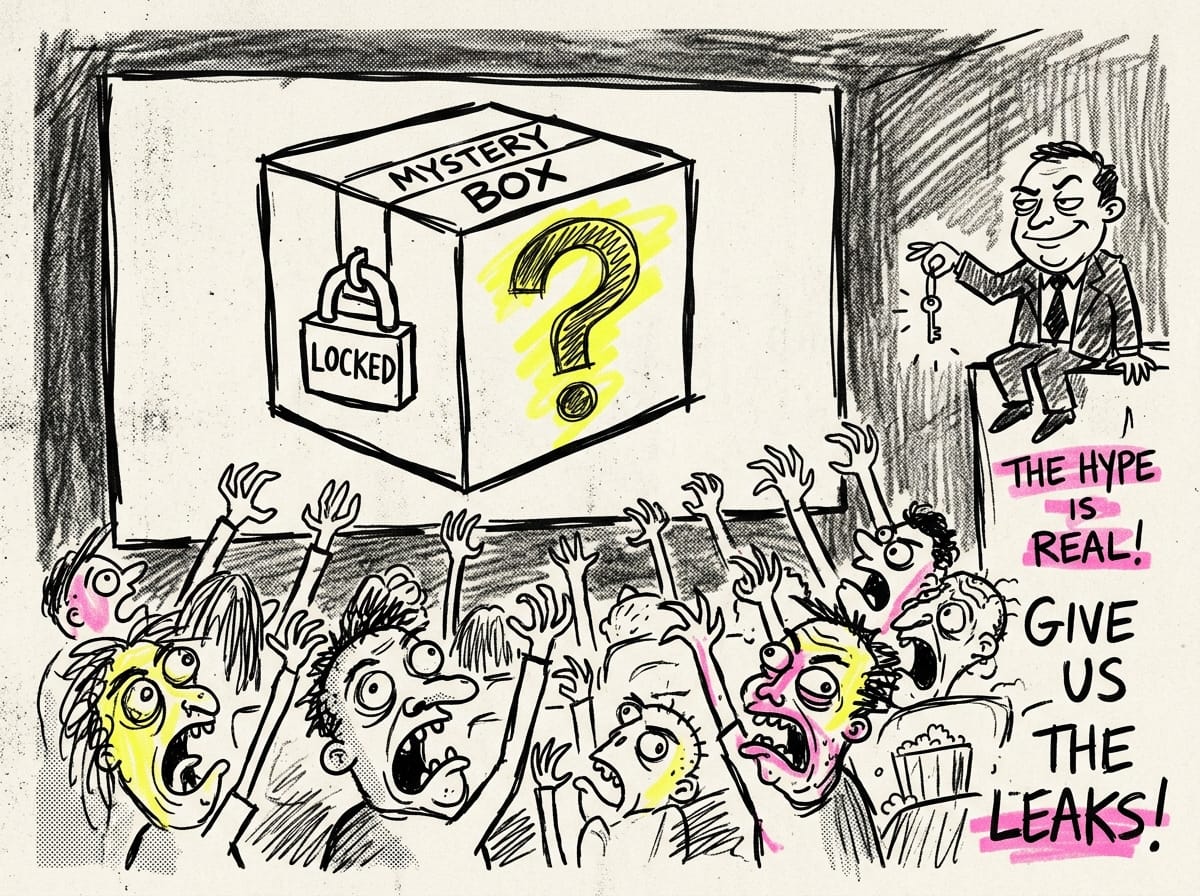
A train crash, something punching its way out from inside a derailed car, and almost no information about what that something was. Classic mystery-box marketing: the teaser is a locked box, and the only way to open it is a ticket.
5. Prometheus — scale without story
Grand, ominous imagery and a building sense of dread, but a deliberate refusal to clarify how it connected to the universe everyone suspected it belonged to. It sold atmosphere and association, not plot.
6. Star Wars: The Force Awakens — a rolling droid and a held breath
After a decade away, the teaser leaned almost entirely on iconography and feeling — a desert, a new droid, a voice, the old music. It told you essentially nothing about the story. It didn’t need to. It just needed to make you feel that the thing you loved was back.
7. Godzilla (2014) — a HALO jump into dread
Soldiers parachuting through smoke and ruin, the creature mostly obscured, Ligeti’s eerie choral music doing the heavy lifting. It withheld the monster — the one thing everyone bought a ticket to see — and was more tantalising for it.
8. The Blair Witch Project — barely a film at all
The marketing’s genius was making you unsure whether you were watching a trailer or evidence. Minimal footage, maximal ambiguity, a whole campaign built on maybe this is real. The less it showed, the more your imagination filled in — and imagination is scarier than any footage.
9. Alien (1979) — the egg and the scream
A slowly cracking egg, a rising tone, the now-legendary tagline about no one hearing you scream. Almost no footage of the creature or the plot. Pure atmospheric dread, sold on a single image and a line of text.
10. Monsters, Inc. / Pixar teasers — the joke instead of the film
Pixar perfected the original-scene teaser — a short comic sketch made just for the teaser, not in the film at all, that sold the characters and tone without revealing a frame of actual plot. Showing nothing of the story, in the most charming possible way.
Why showing nothing works
There’s real psychology under all this, and it’s worth understanding, because it’s the exact opposite of the spoiler problem.
A teaser that withholds is exploiting the information gap — the itch the brain feels when it knows there’s something it doesn’t know. Give someone the whole plot and the itch is gone; they can decide “seen it, basically.” Give them a roar, a head rolling down a street, and no name, and the itch becomes unbearable. They have to close the gap. The only way to close it is to see the film.
Withholding also outsources the work to your imagination, which is always more powerful than footage. The monster you don’t see is scarier than any monster they could show. The plot you can’t piece together is more intriguing than any plot they could explain. By refusing to fill in the blanks, the teaser conscripts your own brain into doing its marketing for it — and your brain works for free, all night, while you lie awake wondering what the hell that thing was.
And finally, restraint is a confidence signal. A teaser brave enough to show almost nothing is implicitly telling you the film is strong enough not to need the hard sell. We read that confidence and trust it — which is the cruel joke, because the full trailer that follows will usually show far too much and spoil half of it anyway.
The teaser is the trailer at its most disciplined. It knows the most powerful thing it can do is make you want — and that wanting is built from absence, not abundance.
Which teaser had you counting down the months?
This is Trailer Trash. We make trailers for films that don’t exist — and write about the ones that do. Follow along on [YouTube], [TikTok], [Instagram], and [X].