The Hidden Three-Act Structure Inside Every Trailer
Watch enough trailers and you feel a rhythm you can't name — a strong open, a lull, a build, a cut to black. It's not coincidence. It's a blueprint.
Watch enough trailers and you start to feel a rhythm you can’t quite name. A strong open. A lull. A build. A sudden cut to black. A final sting.
That isn’t coincidence or house style. It’s a blueprint — one that professional trailer editors reach for so consistently it might as well be law. Once you can see it, every trailer in the multiplex starts running on the same hidden clock.
It borrows the film’s structure — then breaks the ending
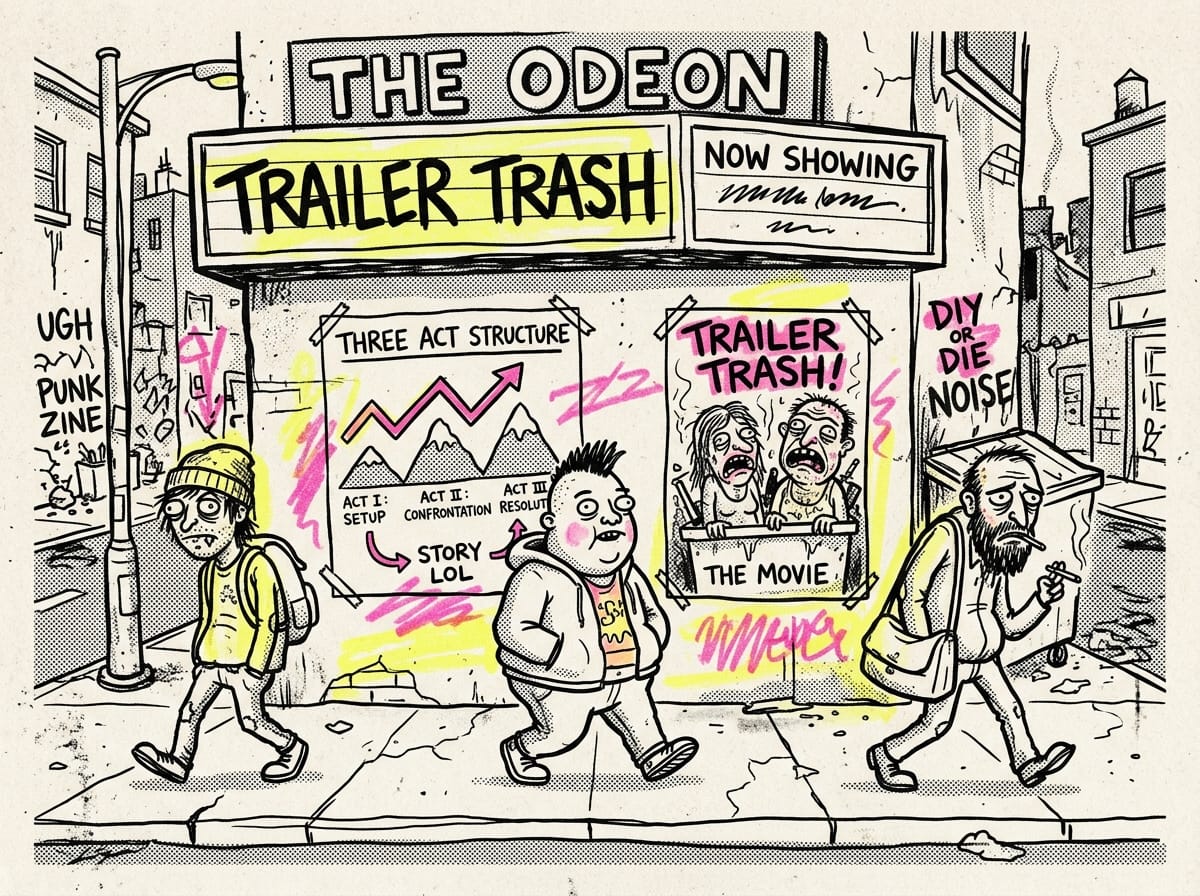
Trailer editors openly describe building to a three-act shape, the same skeleton as a screenplay. Act one introduces a world and its characters. Act two complicates that world with conflict. Act three intensifies everything — and this is where the montage lives.
But there’s one decisive difference from the film it’s selling. A screenplay resolves. A trailer never does. The cardinal rule editors repeat is simple: never resolve anything. Raise every question, answer none. Tie up no loose ends. The whole machine exists to leave you leaning forward.
The cold open comes first
Before act one, most trailers smuggle in a fourth piece: the cold open. A LOT of trailers start with a short, arresting hook before the structure proper kicks in — a striking image, a line of dialogue, a moment designed to stop your thumb mid-scroll.
The logic is counterintuitive but ruthless. Start strong to grab attention, then deliberately calm down, so the build back up has somewhere to climb from. As one veteran editor puts it, if a trailer feels high-energy the whole way through, none of it feels high-energy. Contrast is the engine. The quiet middle is what makes the loud ending land.
A trailer that’s exciting the whole time isn’t exciting at all. The lull is load-bearing.
The music was built in three pieces too
Here’s the part most viewers never notice: the score is often assembled to match the act breaks. Editors frequently start by laying a “music bed” of around three cues — one per act — before cutting a single frame of picture. The audio sets the tone and the pace, and the visuals get hung onto it afterwards.
It’s why trailers so often accelerate — each section pushing harder into the next. And many of the crashes, booms, and that signature low braaam aren’t even in the music. They’re sound effects cut in on top, punctuation marks laid over the beat.
The dialogue follows a pattern, not a plot
Inside the story-heavy first two acts, editors rarely let dialogue run unbroken. The rhythm tends to go: line — moment — line — moment. A piece of dialogue, then a visual beat to breathe, then another line. A constant stream of plot information feels like work; the alternating pulse keeps it effortless.
Each little run of shots is its own mini-scene — sometimes just two or three shots — telling a tiny story before cutting away. And each one, like the trailer as a whole, is engineered to stay unresolved.
The cut to black, and the stinger
Then the climax: the music swells, the best shots fire in rapid succession, and at the peak — silence. The cut to black. The title card.
And just when you think it’s over, the stinger: one last shot, usually the funniest line or the most shocking image, dropped after the title like a parting gift. It’s the taste left in your mouth as the lights come up.
Once you see it, you can’t unsee it
The next trailer you watch, count the beats. Cold open. The calm of act one. The complication. The accelerating montage. The cut to black. The stinger after the title. It’s almost always there.
That’s not a creative failure — it’s a refined piece of engineering, perfected over decades. It’s also why some trailers end up better than the films they sell: the structure is doing work the film never has to. And it’s worth knowing why the music is almost never the real song — because that’s a trick all its own.
This is Trailer Trash. We make trailers for films that don't exist — and write about the ones that do. Follow along on , , , and .