Why the Trailer Never Uses the Real Song
That slow, eerie, minor-key cover of a song you know? It's a deliberate machine for making you feel something — and there are three reasons trailers reach for it.
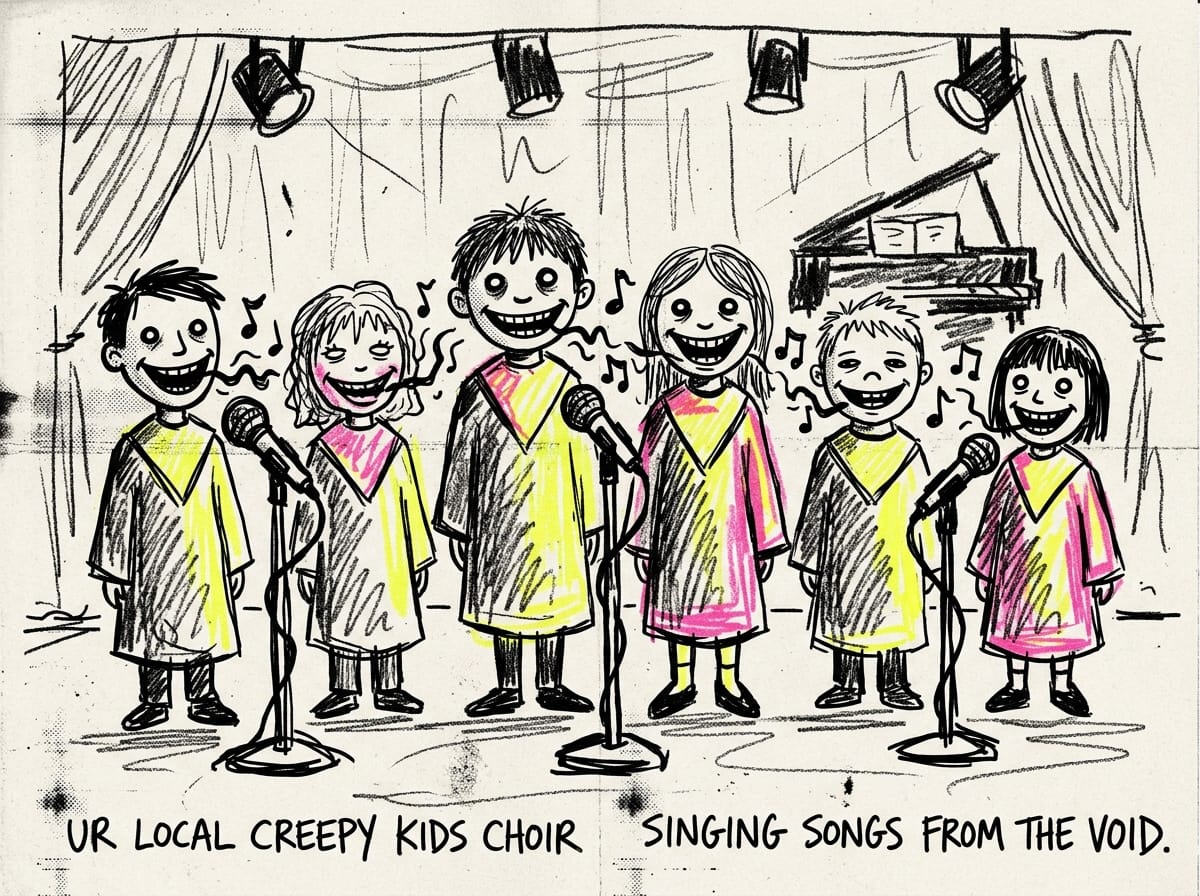
You know the sound. A song you recognise — a pop hit, something bright and familiar — but wrong. Slowed to a crawl, stripped to a single piano or a children’s choir, pitched into a minor key until it’s beautiful and a little sinister. The trailer cover version. Once you notice it, you hear it everywhere.
It’s not laziness and it’s not an accident. It’s a deliberate machine, and it runs on three things.
Reason one: the eeriness is the point
Take a song the audience already loves and make it strange, and you do something a brand-new piece of music can’t. You trigger recognition and unease at the same time. The brain goes “I know this” and “something is wrong with it” in the same beat — which is exactly the feeling a thriller or a horror film wants to sell.
The classic is The Social Network: a Belgian girls’ choir (Scala & Kolacny Brothers) singing Radiohead’s “Creep” as a slow, aching dirge, over images of Facebook quietly swallowing the world. The original is a rock song about alienation. The cover turns it into a hymn about it. The familiarity makes it land; the distortion makes it haunt.
Take a song people love, make it slow and wrong, and you get recognition and dread in the same second. That’s the whole trick.
Reason two: contrast and control
A trailer is a tightly engineered emotional ride — a build, a drop, a climax. The original recording of a famous song has its own arc: its own tempo, its own loud and quiet bits, baked in by the band. That fights the editor.
A custom cover can be built to the trailer’s shape instead — start sparse, swell exactly where the cut needs it to swell, hit the silence at exactly the right frame. The cover isn’t just moodier; it’s obedient. It does what the edit needs, when the edit needs it.
Reason three: the money, and the calculation
There’s a blunt commercial layer too. The more famous a recording, the more it costs to license — sometimes eye-wateringly so. A fresh cover, recorded specifically for the spot, can be far cheaper than clearing the original master.
This is sometimes a saving grace for a smaller film: a striking cover can give a low-budget trailer the emotional punch of a song it could never have afforded to use in the original. The constraint becomes the style.
The fingerprints are everywhere
Once you’re listening for it, the catalogue is huge. The Smashing Pumpkins track on the Watchmen trailer — itself recycled from the soundtrack of a Batman film. Johnny Cash’s cover of Nine Inch Nails’ “Hurt” promising that Logan would be a different kind of superhero film. A cyber-goth “Immigrant Song” for The Girl with the Dragon Tattoo. Each one chosen because the cover did something the original couldn’t.
And there’s a small, telling detail in the Social Network example: the American trailer quietly changed the song’s most famous lyric — the “so f---ing special” line — to “so very special,” to keep it clean. Even the words get re-engineered to fit the job.
That’s the trailer in a nutshell: it doesn’t borrow a feeling, it manufactures one — re-recording, re-pitching, and re-cutting until the sound serves the edit. It’s the audio version of the same logic behind the whole three-act trailer structure. And when the song choice is perfect, it can carry the entire trailer — as these did.
This is Trailer Trash. We make trailers for films that don’t exist — and write about the ones that do. Follow along on [YouTube], [TikTok], [Instagram], and [X].