Why Movie Trailers Stopped Talking to You
There was a year when every single top-ten film had a narrator. A decade later there were none. Here's what killed the voice in the dark.
There was a year, 1994, when every single one of the ten highest-grossing films at the box office had a trailer with a narrator. The Lion King had one. Dumb and Dumber had one. The booming voice was so total, so assumed, that nobody thought of it as a choice.
Twenty years later, almost none did. The voice didn’t fade. It fell off a cliff. And the story of why is stranger than “the famous guy died” — though that’s part of it.
The voice that became a punchline
By the mid-2000s, the trailer voiceover had a problem: everyone could do an impression of it. “In a world…” had stopped being dramatic and started being funny. When a thing becomes that easy to parody, it’s already dying.
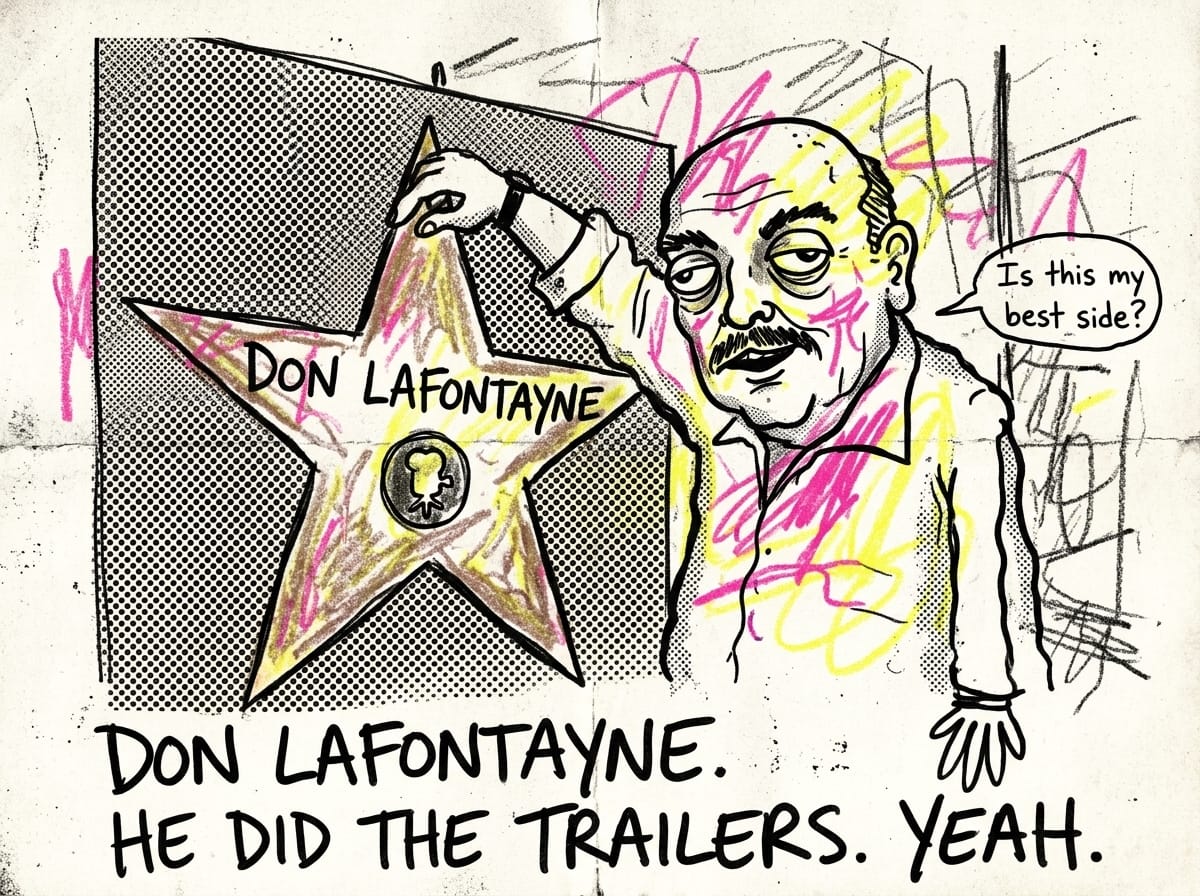
The death certificate, if you want one, is a 2006 Geico commercial starring Don LaFontaine — the genre’s reigning king — billed as “that announcer guy from the movies,” doing his own shtick with a grin. When the most serious voice in Hollywood is in on the joke, the joke is over.
The moment the voice could do a commercial about being the voice, it had already stopped being the voice.
The man, and the gap he left
Then, in September 2008, LaFontaine died. He had voiced more than 5,000 trailers; he was, functionally, the standard. And the standard had no obvious successor.
But here’s the part the tidy version gets wrong: LaFontaine’s death didn’t cause the extinction. The voiceover was already in steep decline before 2008. His passing just removed the one person who might have kept it alive by sheer gravitational pull — and once he was gone, there was no reason left to resist a shift that was already happening.
What actually replaced it
The deeper cause is what films became.
In the voiceover era, a trailer had a job: quickly tell a theatre full of strangers what this unknown movie was about. A narrator did that fast. But the modern box office runs on franchises with built-in fanbases — the Marvel films, the Harry Potter series, sequels and reboots and adaptations. When the audience already knows the world, the characters, the stakes, you don’t need a man to explain them. You just need to show them the thing they already love and let the music swell.
So the voice was replaced by: a needle-drop pop song, snippets of real dialogue, hard cuts of text on screen, and a wall of sound design — including that low braaam. The trailer stopped telling and started hitting.
A lost instrument
There’s a real loss in it, even if you don’t miss the cheese. The voiceover was a craft — timing, weight, the ability to make a mediocre film sound like an event with four words. It was also, at its best, genuinely thrilling.
But trailers are creatures of their time, and their time moved on. The booming narrator belongs to an era when you walked into a cinema not knowing what you were about to see. We don’t live there anymore. We’ve already seen the teaser, read the casting news, watched the reaction videos.
The voice went quiet because, somewhere along the way, there was nothing left for it to introduce. If you want the man behind it, his story is here — and if you’ve ever wondered why we call them “trailers” at all, that’s a stranger tale still.
This is Trailer Trash. We make trailers for films that don’t exist — and write about the ones that do. Follow along on [YouTube], [TikTok], [Instagram], and [X].