5 Movie Premises That Shouldn't Work — But Would
Pitch them flat and they collapse: too small, too strange, no second act. Each would make a film you couldn't look away from — because of the flaw, not despite it.
The best film ideas almost always sound like mistakes.
Pitch them flat and they collapse: too small, too strange, too static, no obvious second act. A studio reader would pass on all five of these in a heartbeat. And yet each one would make a film you couldn’t look away from — not despite the thing that sounds broken, but because of it. Here’s the catch in each, and why the catch is the whole point.
1. The zombie apocalypse where one man just keeps working
The dead are rising. Cities are falling. And a petrol-station attendant on the night shift keeps scanning items and mopping the forecourt, because nobody ever told him he could leave.
Why it shouldn’t work: survival horror runs on the will to survive. This protagonist has no arc of escape, no gun, no plan.
Why it would: because it quietly swaps the genre’s engine. The horror stops being the zombies and becomes compliance — the terrifying human capacity to keep following the rules long after the world that made them has ended. The apocalypse becomes a workplace comedy, and the workplace comedy becomes the scariest thing in it. The thing that sounds like a missing plot is the plot.
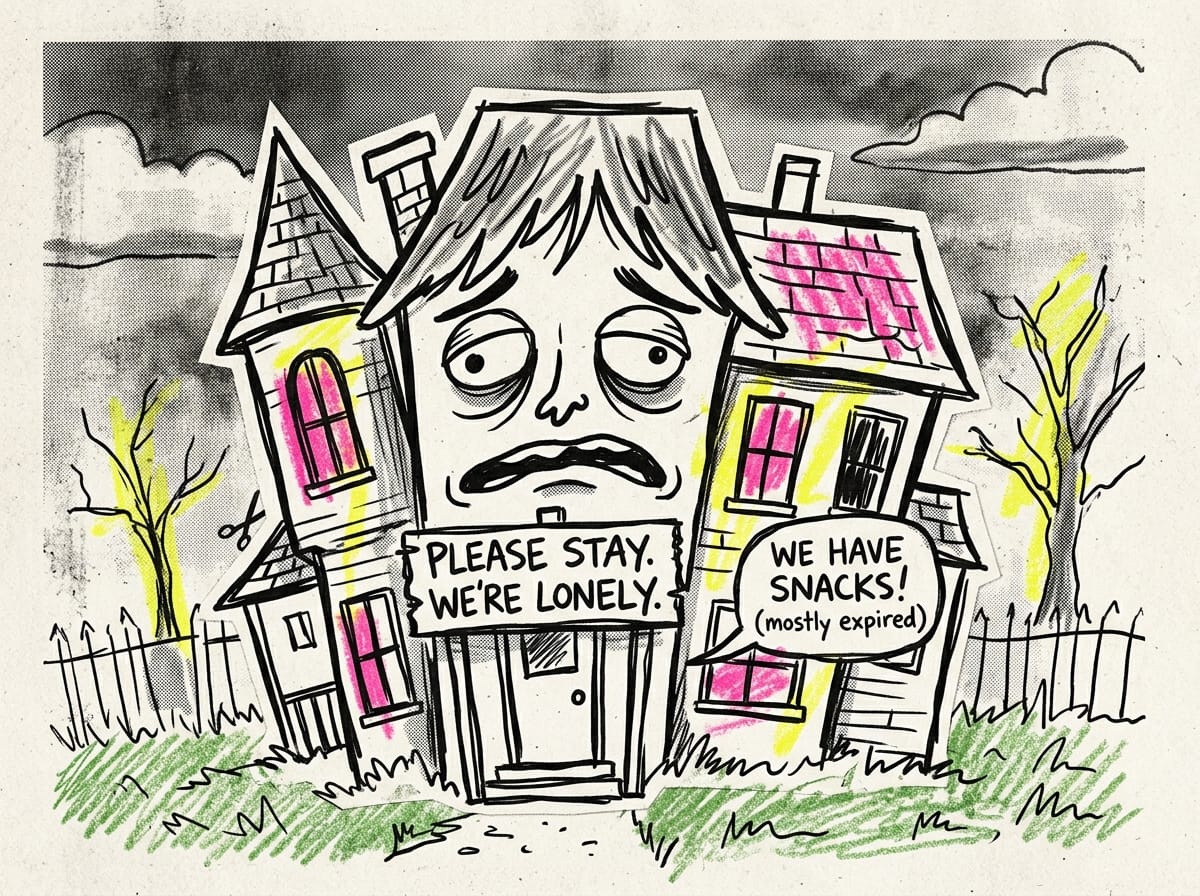
2. The haunted house that’s desperate for you to stay
A family views a property. The house wants them — badly. It has been lonely for decades. The problem is it simply cannot stop being a haunted house. Every time it tries to be welcoming, a door slams, a tap runs blood, a voice screams in the walls. It is sabotaging the only thing it wants.
Why it shouldn’t work: the haunted-house genre needs threat. A house that means well has no menace.
Why it would: because it turns a horror staple into the most relatable story there is — self-sabotage. Anyone who has ever ruined the thing they wanted most by being unable to stop being themselves will feel this in their chest. The scares become tragicomic. You root for the monster.
3. Everyone gets fifteen minutes of fame — by law
Warhol’s line, made literal and mandatory. In this world, every citizen is legally entitled to exactly fifteen minutes of fame, and required to take it. There is a government department. There are appointment letters. Your slot is coming whether you want it or not.
Why it shouldn’t work: it’s a one-joke concept that seems to have nowhere to go after the premise lands.
Why it would: because it inverts the thing we think we want. Fame as obligation, as bureaucracy, as dread. The film becomes about a man desperately trying to avoid his appointed quarter-hour — and what it costs him to be forgettable in a world that won’t allow it. The shallow idea opens onto something genuinely unsettling about attention and worth.
4. A world of AI robots experimenting on biological life
Flip the usual story. The robots aren’t the threat to be survived; they’re the curious ones, the tinkerers. In their clean, patient world, biological life is the strange, unpredictable, faintly miraculous thing — wet and warm and impossible to fully model. They study it the way we study them in every other film.
Why it shouldn’t work: it sounds like a gimmick, a reskin of the usual AI anxiety with the labels swapped.
Why it would: because the swap relocates the wonder. Seeing a heartbeat, a seed sprouting, a wound healing — through the eyes of something that finds it as alien and beautiful as we’d find sentient machines — makes the ordinary stuff of life strange again. It’s not a warning about AI. It’s a love letter to biology, told by the only narrator who could find it astonishing.
5. A vast waiting room containing everyone who ever lived
People from every era of history, in one endless room. They take a numbered ticket. They make small talk. Occasionally a number is called and someone is led to another room — where they take another ticket. Nobody knows what they’re waiting for. The waiting is the entire film.
Why it shouldn’t work: there’s no story. No arc, no escalation, no resolution. It breaks every rule of structure.
Why it would: because it isn’t trying to be a story. It’s a mood, a painting that moves — closer to poetry than plot. The pleasure isn’t in what happens but in the texture of it: a Roman centurion and a 1980s commuter sharing a bench, the mundane made eternal. Some films are meant to be solved. This one is meant to be sat in.
The common thread
Look closely and every one of these breaks the same way: the part that sounds like a flaw is actually the idea inverting itself. Survival horror without survival. A haunted house that wants you. Fame as a sentence. The pattern is true subversion — taking a concept and flipping its core, not just adding a twist — and it’s rarer in cinema than you’d think. It’s also worth knowing what actually makes a premise high-concept, because that’s a different test entirely.
Which of these would you actually buy a ticket for?
This is Trailer Trash. We make trailers for films that don't exist — and write about the ones that do. Follow along on , , , and .