The Trailer Is the Art Form Now
We watch more trailers than films. We share them, rank them, rewatch them. At some point the advertisement stopped serving the movie and became the main event.
Here’s a question that sounds flippant and isn’t: when did you last watch a trailer you had no intention of using as a trailer? Not to decide whether to see a film — just to watch it. As a thing. Maybe this week. Maybe twice. Maybe you sent it to someone. If so, congratulations: you’ve been treating the trailer as an art form, whether or not you’d ever call it that. And you’re not alone, and it’s not an accident. The advertisement has quietly become the main event.
The numbers gave it away first
Start with the brute fact. We watch vastly more trailers than films. We always have — you see dozens of trailers for every film you actually sit through — but the internet turned that imbalance into something stranger. Trailers are among the most-watched video on earth, consistently ranking near the top of all online video, behind only news and the stuff people make themselves.
That means, for most people, the trailer is no longer a preview of the cinematic experience. It often is the cinematic experience. The two-minute version is the version they’ll see, share, remember, and form an opinion about. The feature film is, for a huge slice of the audience, a thing that other people go and see and report back on. The trailer is what they actually consume.
When the advertisement reaches a thousand times more people than the product, at what point do we admit the advertisement is the product?
It has every quality we demand of an art form
We get snobbish about this because “advertisement” feels like the opposite of “art.” But run the trailer through the tests we apply to any art form and it passes uncomfortably easily.
It has a distinct grammar — a vocabulary of techniques unique to the form: the three-act compression, the strategic silence, the needle-drop, the braaam, the rhythmic acceleration into a title card. These aren’t borrowed from film; they’re native to the trailer. You couldn’t use most of them in a feature.
It has masters and auteurs — the trailer houses and editors who develop recognisable styles, whose work other editors copy, whose innovations ripple across the whole form. The fact that you don’t know their names doesn’t make them less real; you didn’t know the name of the cinematographer on your favourite film either.
It has critical discourse — people rank trailers, dissect them, argue about them, make video essays about them. This very site exists. There’s a culture of trailer connoisseurship that treats a great cut the way film buffs treat a great tracking shot.
It has a relationship between form and feeling — the whole point of the thing is to manufacture a precise emotional state in two minutes flat, using image, sound, and time. That’s not so different from what a poem or a pop song does. Brevity isn’t the absence of artistry. Ask a sonnet.
The strange case of the trailer better than the film
The most damning evidence is the phenomenon we’ve all experienced: the trailer that’s better than the movie it’s selling. (We’ve made a whole list of them.)
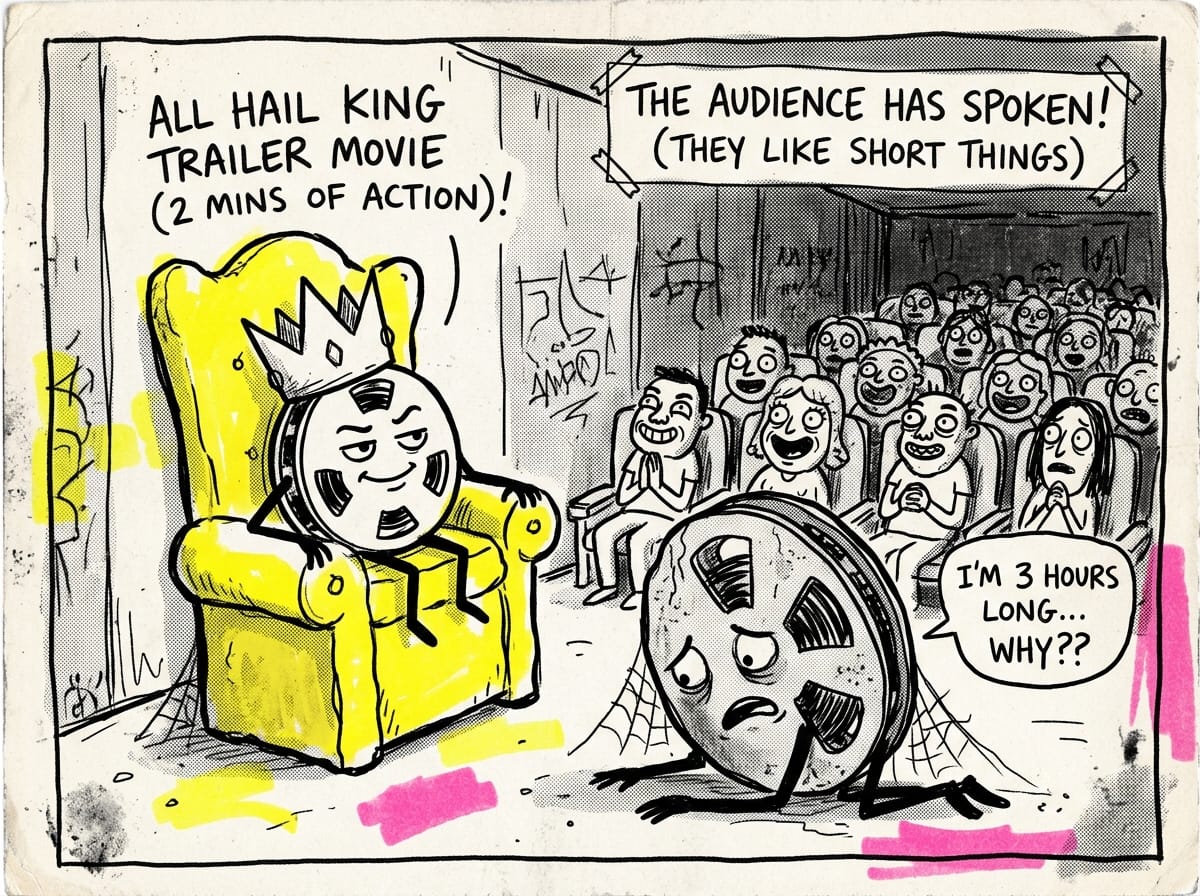
Think about how odd that is. It should be impossible for the advertisement to outclass the product — the advertisement is made from the product. And yet it happens constantly, because the trailer and the film are doing genuinely different things. The film has to sustain a story for two hours, with all the connective tissue and slow patches that requires. The trailer gets to be pure highlight, pure feeling, pure rhythm — two minutes of nothing but the best parts, arranged for maximum impact. In a sense, the trailer is film concentrated past the point the film itself can reach. No wonder it sometimes hits harder.
A trailer better than its film isn’t a failure of the film. It’s proof the trailer is a separate art form with its own ceiling — one that occasionally clears the bar the feature couldn’t.
What it means that we won’t admit it
So why do we resist calling it art? Partly snobbery about commerce — we’ve decided things made to sell other things can’t be beautiful, which would surprise every cathedral and every Renaissance altarpiece ever commissioned. Partly because it’s new, and we’re always slow to grant art-form status to forms younger than we are. Music video took decades to be taken seriously. Video games are mid-argument. The trailer hasn’t even started its trial.
But the audience has already voted with its attention. We watch trailers we’ll never “use.” We rewatch them. We have favourites. We feel let down by a bad one the way you feel let down by a bad song. We are, collectively, consuming trailers as art while loudly insisting they’re just adverts — which is exactly the behaviour of a culture that hasn’t yet caught up with its own tastes.
The honest conclusion
Here’s the position, stated plainly, because hedging it would be cowardly: the movie trailer is the dominant cinematic art form of the streaming age. It’s the version most people see, the version most widely shared, the version with the richest native grammar and the most rewatch value per minute. The feature film is the prestige object the trailer is made from — increasingly the way an album is the thing a hit single comes from, respected but less lived with.
You don’t have to like that. Plenty of people think the single killed the album and they’re not entirely wrong. But the trailer didn’t sneak into the position of main event by cheating. It earned it the way any art form does — by getting extraordinarily good at doing something only it can do.
We make trailers for films that don’t exist, on this site, precisely because we believe the trailer is worth making for its own sake — film or no film. Turns out the rest of the world has been quietly agreeing all along.
This is Trailer Trash. We make trailers for films that don’t exist — and write about the ones that do. Follow along on [YouTube], [TikTok], [Instagram], and [X].