What Actually Makes a Premise "High-Concept"
The term gets thrown at any flashy idea. But high-concept is a precise, ruthless test — and most films that claim it fail. Here's the real definition.
“High-concept” is one of those terms everyone uses and few define. It gets slapped on anything loud, expensive, or vaguely clever — a big sci-fi swing, a flashy gimmick, a film with a poster that pops. But high-concept actually means something specific, and the real definition is more ruthless and more useful than the loose one. Most films that get called high-concept aren’t. Once you know the test, you can apply it in about four seconds.
The actual test: one sentence, no film required
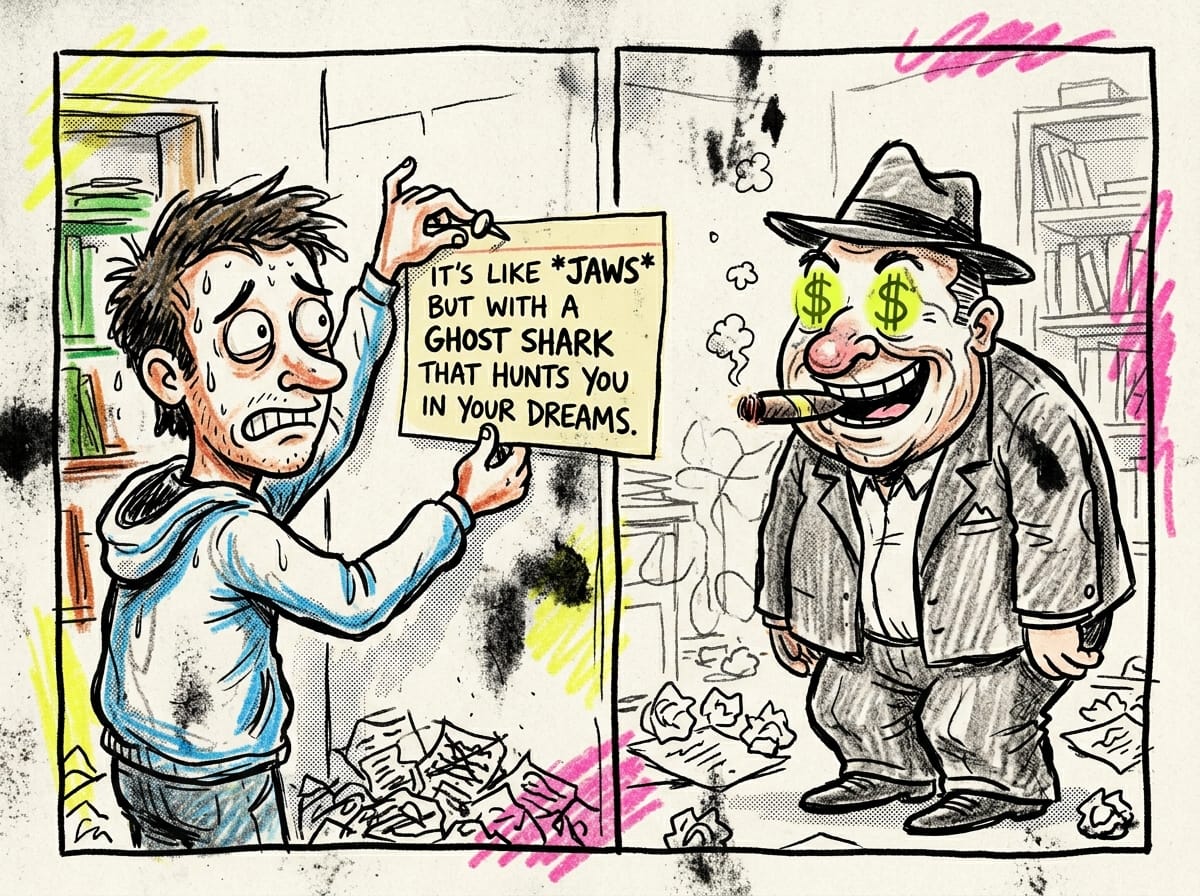
A premise is high-concept if you can sell it in a single sentence, to someone who knows nothing about it, and they instantly get it — they understand the hook, the appeal, and roughly what the experience would be, without needing to see a frame.
That’s it. That’s the whole test. Not “is it a big idea.” Not “is it clever.” Can a stranger grasp the entire appeal from one line?
- A shark terrorises a beach town. (Jaws.)
- A businessman and a sex worker fall in love over a week. (Pretty Woman.)
- Dinosaurs are cloned for a theme park, and it goes wrong. (Jurassic Park.)
- A man relives the same day over and over. (Groundhog Day.)
- Passengers on a bus will die if it drops below 50mph. (Speed.)
You didn’t need me to explain any of those. You already knew if you wanted to see it. That instant, frictionless transmission of the whole appeal in one line — that’s high-concept. The concept does the selling. The execution is almost a separate question.
High-concept isn’t “a big idea.” It’s an idea so clear that a stranger is sold by the sentence, before a single frame exists.
The opposite: low-concept (which is not an insult)
The counterpart is low-concept, and crucially this isn’t a put-down — it describes some of the greatest films ever made. A low-concept film is one whose appeal lives in execution, character, theme, mood, performance — things you cannot compress into a sellable sentence.
Try to one-line a character drama: a man has a midlife crisis. That’s not a hook; it’s a thousand films. The greatness of any specific one lives in the how, not the what — the writing, the acting, the specificity. You can’t sell it on the premise because the premise isn’t the point. That’s low-concept, and it’s where most of cinema’s deepest work lives.
So the high/low axis isn’t quality. It’s where the appeal lives — in the idea (high) or in the execution (low). A high-concept film can be terrible; a low-concept film can be a masterpiece, and vice versa. They’re just sold differently, because they work differently.
Why this matters more in the trailer age
Here’s why a trailer site cares about this at all: high-concept and the trailer are made for each other.
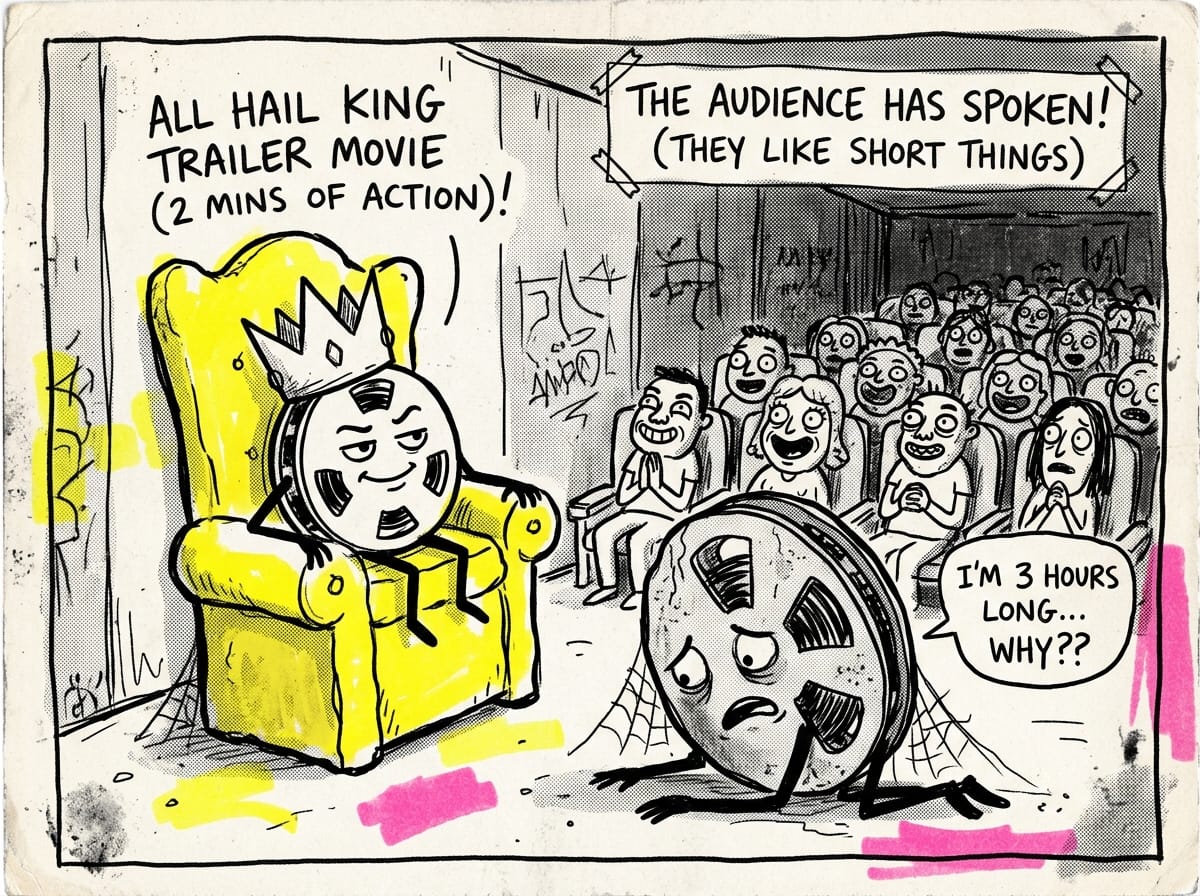
A trailer is a compression machine — its job is to transmit the appeal of a film in roughly two minutes to a distracted stranger. A high-concept premise is already compressed; it’s practically a trailer in one sentence. So high-concept films cut into spectacular trailers almost automatically: show the shark, show the bus, show the loop, and the audience is sold. The premise and the promo are the same shape.
Low-concept films, by contrast, are murder to trailer — which is exactly why their trailers so often mislead. You can’t sell a subtle character study on its premise, so the trailer has to manufacture a fake hook: invent a plot, imply a genre it isn’t, stitch together the only three “exciting” moments. The mismatch between a low-concept film and its forced high-concept trailer is the source of half the trailers that lie or oversell. The trailer is reaching for a one-sentence hook the film was never built to provide.
High-concept is not the same as subversive
This is the trap worth flagging, because the two get confused constantly. A high-concept premise is clear. A subversive premise flips an expectation. They’re different axes entirely, and the most interesting ideas often combine them.
High-concept asks: can you sell it in a sentence? Subversive asks: does it invert the genre’s engine? You can be one without the other. “A shark terrorises a beach town” is pure high-concept and not remotely subversive — it delivers exactly the genre it promises. Meanwhile a deeply subversive idea might be hard to one-line, because the whole point is that it doesn’t behave the way its sentence implies.
The sweet spot — and it’s rare — is a premise that’s both: instantly graspable in a line, and secretly inverting what that line leads you to expect. “A petrol-station attendant keeps working the night shift through the zombie apocalypse because no one told him he could leave.” You get it in one sentence (high-concept), and it quietly flips survival horror into a film about compliance (subversive). That combination is the holy grail, and it’s what we keep hunting for.
How to use the test
Next time you hear a film idea — yours or anyone’s — run it through the four-second check. Say it in one sentence and watch the listener’s face. If they instantly light up and get it, it’s high-concept; the idea will sell itself and cut a great trailer. If they need a follow-up — “okay, but what’s it about?” — it’s low-concept, and its power will have to come from execution, which is harder to sell but often deeper to watch.
Neither is better. But knowing which one you’ve got tells you everything about how to develop it, how to pitch it, and — the part we care about most around here — how on earth you’re going to cut the trailer.
This is Trailer Trash. We make trailers for films that don’t exist — and write about the ones that do. Follow along on [YouTube], [TikTok], [Instagram], and [X].